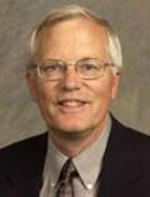
Presented by Robert Olsen
Energy System Innovation Center, Washington State University
Wednesday, March 11 • 10-11 AM • EME 26
View Recorded Seminar
Overview
Faraday shields are used to confine high frequency electromagnetic fields generated by sources such as switching electronics within them. Here, a simple cylindrical model of a Faraday shield is used to explain why such shields can be compromised by one or more conductors that penetrate through holes in the shield. It is shown that electromagnetic fields within the shield are reflected many times and that the energy carried by the fields exits via the penetration periodically in small amounts over time and may become electromagnetic interference (EMI). The fields inside the shield are enhanced at resonant frequencies within the shield and these resonances are reflected in the fields that escape and become EMI. In cases for which filtering of these exit ports are not practical, it is shown that placing absorbing material within the shield can reduce the energy that escapes and hence the EMI. Index Terms: Shielding Integrity, Faraday Shields, Electromagnetic Interference
Bio
Dr. Robert G. Olsen received his BS degree in electrical engineering from Rutgers University, New Brunswick, NJ in 1968 and his MS and PhD degrees in electrical engineering from the University of Colorado, Boulder, CO in 1970 and 1974, respectively. He has been a member of the electrical engineering faculty at Washington State University since 1973 and holds the rank of Emeritus Professor. During his tenure at WSU, he has been an NSF Faculty Fellow at GTE Laboratories in Waltham, MA, a visiting scientist at ABB Corporate Research in Västerås, Sweden and the Electric Power Research Institute (EPRI) in Palo Alto, CA, and a Visiting Professor at the Technical University of Denmark. His research interests span all aspects of electromagnetics issues in power transmission. His work in these areas has resulted in approximately 100 publications in refereed journals and approximately 150 conference publications/presentations. He is a Fellow of the IEEE, an Honorary Life member of the IEEE Electromagnetic Compatibility Society, and has served as chair of the IEEE Power Engineering Society AC Fields and Corona Effects Working Groups. In addition, he is past Associate Editor of the IEEE Transactions on Electromagnetic Compatibility and Radio Science.