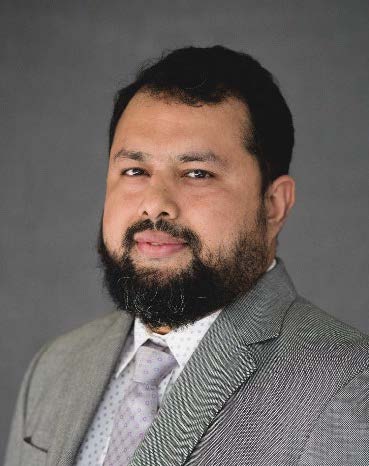
Presented by Md. Aamir Rahmani
Schweitzer Engineering Laboratory, Inc.
Wednesday, February 4 • 10-11 AM • EME 26
View Recorded Seminar
Seminar Abstract
This seminar compares two Digital Secondary System (DSS) technologies for substation protection: IEC 61850 process-bus Sampled Values (SV) and point-to-point TiDL. It begins by motivating DSS adoption (reduced copper, improved safety, greater flexibility) and then asks how communication behaviors become protection behaviors. For SV, we review merging units, publisher–subscriber messaging, and the role of time (PTP) in aligning sampled currents and voltages. Using phasor-based distance protection as an example, we show how phasor extraction and impedance calculations are sensitive to SV channel delay (MU processing plus network delay), and packet loss, compromising security and dependability.
We then discuss consolidates mitigation strategies used in relays and settings: deterministic wait-time coordination, SV status-bit supervision of torque equations, limited-gap interpolation, and blocking/freezing vulnerable elements during data loss with a settling block after restoration. TiDL is presented as a contrasting architecture that uses direct fiber links between a field merging unit and relays, avoiding switched protection networks and external time for protection, simplifying commissioning and shrinking the attack surface, while trading off some interoperability and process-bus flexibility. We close with selection criteria for bay count and cost.
Bio
Dr. Md Aamir Rahmani holds a diploma in electrical engineering from Jamia Millia Islamia, India; B.Tech in Electronics and Instrumentation Engineering from Galgotias College, India; and MS and PhD in electrical engineering from Michigan Technological University. Aamir joined SEL in May 2024 where he is a Lead Integration and Automation Engineer with the Protection Systems Department in R&D. Aamir began his career in the power industry as a Project Engineer with Schneider Electric, where he specialized in Substation Automation Systems and has since gained 14 years of experience in various roles across industry and academia. He is a member of IEEE, and his Ph.D. research involved developing an EMT model for Inverter-Based Resources for protective relay studies.